
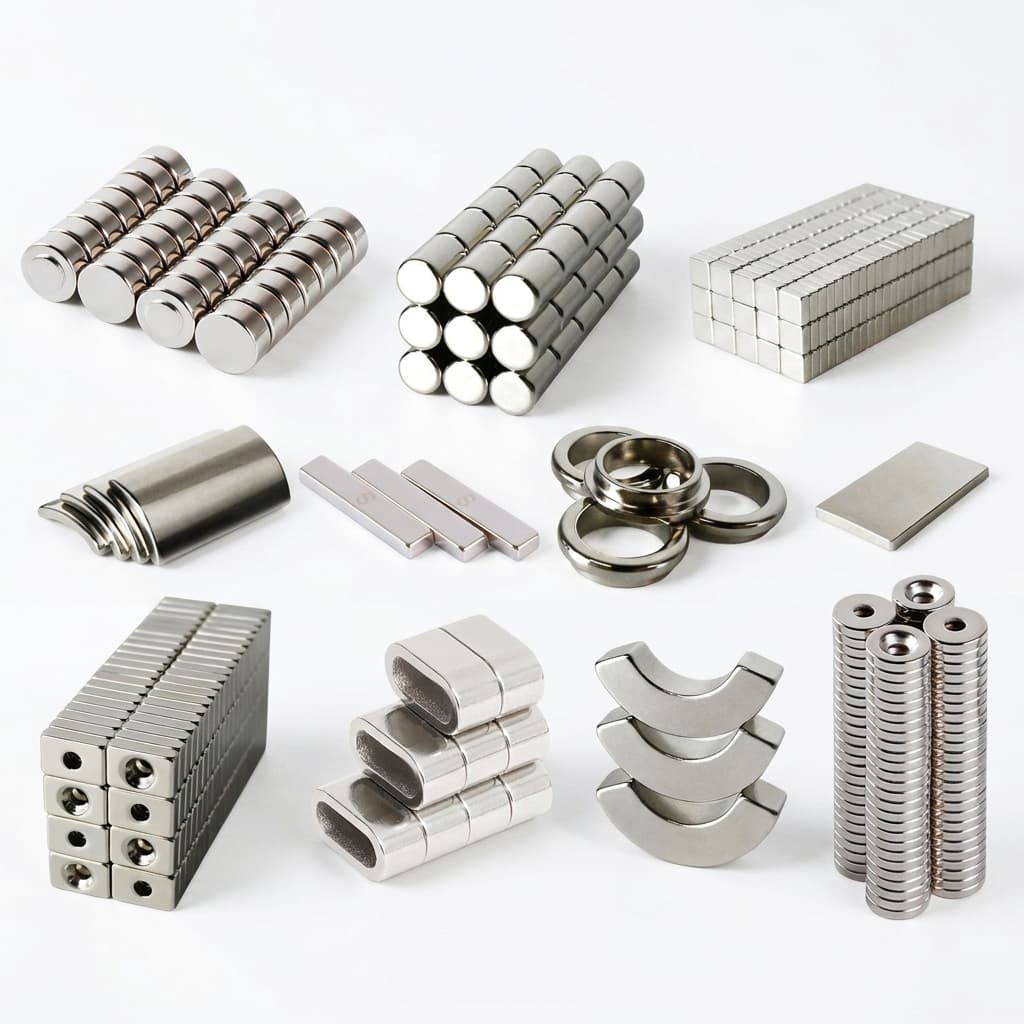
Understanding and Preventing NdFeB Demagnetization: A Buyer's Guide
A comprehensive guide for procurement teams and engineers on how to prevent reversible, irreversible, and structural demagnetization in custom NdFeB magnets.
In the world of custom NdFeB magnets and magnetic assemblies, one of the most frustrating and costly failures a procurement or engineering team can face is demagnetization. You run the initial prototypes, validate the pull force at room temperature, sign off on the RFQ, and move into mass production. However, six months later, field reports indicate that the sensors are failing to trigger, or the BLDC motors are losing torque. The magnets have lost their strength.
When buyers issue an RFQ for custom NdFeB magnets, the focus is often heavily weighted toward finding the lowest unit price for a given shape and basic grade (like N35 or N52). But treating custom magnets like simple commodity hardware ignores the complex physics that dictate how these components behave under stress. NdFeB magnets are highly sensitive to thermal, magnetic, and environmental variables.
Understanding the mechanics of demagnetization—and knowing exactly how to specify your requirements to prevent it—is the difference between a reliable, long-term product and a catastrophic recall. This comprehensive playbook breaks down the exact causes of magnetic loss, explains how to interpret supplier data, and provides a clear framework for locking down your RFQ to guarantee long-term stability.
Scope and update note (updated July 22, 2026): This guide is written for global OEM buyers and engineers specifying custom NdFeB magnets for motors, sensors, latches, couplings, and sealed assemblies. It is not a substitute for supplier B-H curve review, FEA, or validation testing at your exact geometry, coating, adhesive, and duty cycle. For an application-specific grade review, compare the product options above or send your operating temperature and CAD constraints to our engineering team.
1. The Three Types of Magnetic Loss
Before writing a specification, it is critical to understand that not all magnetic strength loss is the same. There are three distinct categories of demagnetization that occur when an NdFeB magnet is exposed to elevated temperatures.
Reversible Loss
Reversible loss occurs when a magnet is heated slightly above room temperature but stays well within its safe operating limits. As the temperature rises, the thermal energy causes the magnetic domains within the material to vibrate, temporarily reducing the net magnetic output.
For standard NdFeB magnets, the magnetic flux decreases by approximately 0.11% to 0.12% for every degree Celsius increase. This means if you design a magnetic latch to operate at 20 C and it heats up to 60 C, the magnet will be noticeably weaker. However, this loss is entirely reversible. Once the assembly cools back down to 20 C, the magnet will fully recover its original strength, assuming no other degradation occurred. Engineers must account for reversible loss in their nominal force calculations to ensure the device still functions at its peak operating temperature.
Irreversible Loss
Irreversible loss is the primary failure mode that plagues poorly specified procurement orders. This occurs when a magnet is heated beyond its Maximum Operating Temperature (Tmax), but remains below its Curie Temperature.
When the thermal energy exceeds the stability threshold of the magnetic domains, some of those domains permanently flip their orientation. The magnet is still highly magnetic, but a portion of its original field is gone forever. Even when the magnet is cooled back to room temperature, the lost strength does not return.
If a magnet suffers irreversible loss, it is not ruined permanently in a structural sense—it can theoretically be re-magnetized to its full original strength if exposed to a sufficiently powerful magnetizing coil. However, in practical terms, once a magnet is glued into a motor rotor or sealed inside a medical device, re-magnetizing it is impossible. For the buyer, an irreversible loss in the field means a failed product.
Total Structural Loss (The Curie Temperature Myth)
There is a common misconception among junior buyers that a magnet is safe to use as long as it remains below its Curie Temperature (Tc). This is dangerously incorrect.
The Curie Temperature (typically 310 C to 400 C for NdFeB) is the extreme thermal point where the material undergoes a phase transition from ferromagnetic to paramagnetic. At this exact temperature, the magnet loses 100% of its magnetic properties. While it is a useful theoretical metric, no practical engineering application should ever approach the Curie Temperature. Irreversible loss will destroy the function of the magnet hundreds of degrees before the Curie Temperature is reached. Always specify your purchases based on Maximum Operating Temperature and Intrinsic Coercivity, never the Curie Temperature.
2. Decoding NdFeB Grades and Working Temperatures
The standard nomenclature for NdFeB magnets includes a number (representing the Maximum Energy Product, or BHmax) and often a letter suffix. This suffix is the most important character for demagnetization prevention, as it indicates the material's Intrinsic Coercivity (Hcj) and, by extension, its baseline thermal resistance.
Intrinsic Coercivity is a measure of the material's ability to resist demagnetization from external factors (both thermal energy and reverse magnetic fields). A higher Hcj means a more stable, robust magnet, which requires adding expensive Heavy Rare Earth Elements (HREEs) like Dysprosium (Dy) or Terbium (Tb) during manufacturing.
Below is the standard reference table for NdFeB temperature grades. Note that the "Typical Max Operating Temp" is a general guideline, not an absolute rule (as we will explore in the next section regarding Permeance Coefficient).
| Grade Suffix | Meaning | Typical Max Operating Temp | Min. Intrinsic Coercivity (Hcj) | Typical Application Environment | Cost Premium (Estimate) |
|---|---|---|---|---|---|
| None (e.g., N35) | Standard | up to 80 C | at least 12 kOe | Office goods, basic consumer electronics | Baseline / Lowest |
| M (e.g., N35M) | Medium | up to 100 C | at least 14 kOe | Small DC motors, moderate ambient heat | Low Premium |
| H (e.g., N35H) | High | up to 120 C | at least 17 kOe | Industrial actuators, outdoor sensors | Moderate Premium |
| SH (e.g., N35SH) | Super High | up to 150 C | at least 20 kOe | High-torque BLDC motors, automotive | High Premium |
| UH (e.g., N35UH) | Ultra High | up to 180 C | at least 25 kOe | Heavy industrial equipment, EV traction | Very High Premium |
| EH (e.g., N35EH) | Extreme High | up to 200 C | at least 30 kOe | Downhole tools, aerospace components | Extreme Premium |
| AH/VH (e.g., N35AH) | Advanced High | up to 230 C | at least 33 kOe | Specialized severe environments | Highest Premium |
When releasing an RFQ, it is an amateur mistake to leave the suffix off if your application runs hot. If your device reaches 95 C and you source standard N52 magnet material, the magnets will fail. You must specify an 'M' or 'H' grade minimum, such as N45H. Keep in mind that as thermal resistance (the suffix) goes up, the maximum available strength (the number) generally goes down. You cannot easily buy an N54EH; the metallurgy does not allow it.
3. The Permeance Coefficient (PC) Trap
Even if you memorize the table above, you can still fall into a dangerous engineering trap: assuming the "Max Operating Temp" on the supplier's data sheet is a guaranteed limit.
The supplier's stated Maximum Operating Temperature assumes the magnet is operating in a closed magnetic circuit or has a highly favorable geometry. The actual thermal limit of a magnet is heavily dependent on its shape, which is quantified mathematically by the Permeance Coefficient (PC).
The PC is a ratio derived from the geometry of the magnet (specifically its length in the direction of magnetization compared to its pole cross-sectional area).
- A magnet that is long and thin in the direction of magnetization (like a long cylinder magnetized through its length) has a high PC. It is very stable and will likely survive up to the supplier's stated Max Operating Temp.
- A magnet that is thin and wide (like a coin-shaped disc magnetized through its thickness) has a low PC. It is fighting against its own internal demagnetizing field. A low PC magnet will suffer irreversible demagnetization at temperatures significantly lower than the grade's official rating.
If you are buying thin neodymium disc magnets (e.g., 10 mm diameter x 1 mm thick), the actual maximum temperature before irreversible loss might drop from 80 C down to 50 C for a standard N grade. To fix this without changing the shape, you must source a higher coercivity grade (like an 'M' or 'H' grade) just to survive an 80 C environment.
4. Reverse Magnetic Fields and Motor Applications
Thermal energy is not the only vector for demagnetization. External magnetic fields that oppose the magnet's own field can forcibly flip the magnetic domains.
This is a critical consideration for engineers designing electric motors, generators, or magnetic couplings. In a BLDC motor, the stator coils generate intense electromagnetic fields to push against the permanent magnets on the rotor. During a stall condition (when the motor is jammed and the coils draw maximum current), a massive reverse field is applied to the NdFeB magnets.
If the Intrinsic Coercivity (Hcj) of the magnet is too low, the stall current will irreversibly demagnetize the rotor. The motor will permanently lose torque and run hotter, creating a vicious cycle of further thermal demagnetization until total failure.
To prevent this, procurement must work closely with motor designers to determine the maximum reverse field the magnet will experience. The supplier must then guarantee an Hcj value that safely exceeds this worst-case scenario.
5. Visualizing the B-H Demagnetization Curve
To truly understand how thermal and magnetic stress cause failure, engineers use the Normal and Intrinsic Demagnetization Curves (often called B-H curves).
The curve shows how the magnetic flux density (B) drops as a reverse magnetic field (H) is applied. In the second quadrant of this graph, the line remains relatively flat and straight until it reaches a sharp downward turn known as the "knee" of the curve.
How to read this: As the magnet gets hotter (red line), the entire curve shrinks, and the "knee" moves up and to the left. The green dotted line is your Permeance Coefficient (load line), which is fixed by the physical shape of your magnet. The intersection of the green line and the temperature curve is your Operating Point.
The Golden Rule of Demagnetization: Your Operating Point must always stay above the knee of the curve. If the temperature rises, or a reverse magnetic field pushes the operating point down past the knee into the steep vertical drop, the magnet suffers irreversible loss.
6. The Silent Killer: Corrosion-Induced Demagnetization
A highly overlooked vector for magnetic failure is environmental corrosion. NdFeB magnets contain a high proportion of elemental Iron (Fe) and Neodymium (Nd), making them exceptionally prone to oxidation.
If the protective coating (such as Ni-Cu-Ni or Epoxy) is scratched, porous, or fundamentally inadequate for the environment, moisture will penetrate the surface.
- Oxidation: The iron rusts, turning solid magnetic material into a non-magnetic powder, physically reducing the volume of active magnet.
- Hydrogen Decrepitation: In certain humid or acidic environments, hydrogen atoms can diffuse into the NdFeB crystal lattice along the grain boundaries. This causes the magnet to literally expand, crack, and crumble into dust from the inside out.
From a procurement perspective, a magnet that turns to powder is functionally the same as a magnet that has been demagnetized by heat: the field is gone, and the product has failed. Proper coating specification is just as critical as temperature grading.
For high-humidity or salt-spray environments, do not accept a default Ni-Cu-Ni coating without requiring a specific Salt Spray Test (SST) duration in your quality gates (e.g., passing 72 hours SST). For extreme environments, consider Epoxy or Parylene coatings, or hermetically sealing the magnet inside a stainless steel sleeve.
7. The OEM Sourcing & Engineering Checklist
To prevent demagnetization risks in mass production, buyers and engineers must lock down the following parameters before selecting a supplier:
- Define the Max Ambient Environment: What is the absolute peak temperature the device will sit in (e.g., sitting inside a hot car in summer)?
- Define the Active Heat Load: Does the magnet sit next to a heat-generating component (like a motor coil or a battery)? Calculate the true max operating temperature.
- Review the Permeance Coefficient (PC): Have engineering calculate the PC. If it is less than 1.0 (thin discs/plates), you must over-spec the temperature grade.
- Specify Minimum Hcj: Do not just specify "N42SH". Add an explicit line for "Intrinsic Coercivity Hcj at least 20 kOe" on the drawing.
- Identify Reverse Fields: Will this magnet act as a rotor in a motor? State the maximum stall current/reverse field to the magnet supplier so they can run a B-H curve simulation.
- Require Demagnetization Curves: Force the supplier to provide 2nd quadrant B-H curves for the quoted material at 20 C, 80 C, and your target max temperature.
- Specify the Coating by Environment: Define the environment (e.g., "Outdoors, high humidity") and require a corresponding coating test (e.g., "Epoxy, 96hr SST, no blistering").
If you need a starting point for drawing notes, compare your grade language against our N42 magnet specifications and then request the supplier's high-temperature B-H curves for the exact batch.
8. Frequently Asked Questions (FAQ)
Q: Can a demagnetized NdFeB magnet be fixed? A: If the loss is reversible (from mild heat), it will fix itself upon cooling. If the loss is irreversible, it can be re-magnetized in a factory using a high-voltage magnetizing fixture. If the magnet was heated past its Curie temperature, the metallurgical structure may be altered, and re-magnetization might not restore 100% of the field. In assembled consumer products, "fixing" is virtually impossible.
Q: Will extreme cold demagnetize Neodymium magnets? A: Generally, no. NdFeB magnets actually become stronger at cold temperatures (down to about -130 C). However, below -130 C, they undergo a spin-reorientation transition which can cause magnetic loss. For standard industrial cold environments (-40 C), NdFeB performs excellently.
Q: Does repeated heating and cooling accelerate demagnetization? A: If the peak temperature remains safely above the knee of the B-H curve for your specific geometry, repeated thermal cycling will not cause cumulative demagnetization. However, thermal cycling can cause mechanical stress on the protective coating, potentially leading to micro-cracks, corrosion, and subsequent failure.
Q: Why are 'EH' and 'AH' grade magnets so much more expensive? A: Achieving ultra-high Intrinsic Coercivity requires substituting a portion of the Neodymium with Heavy Rare Earth Elements (HREEs) like Dysprosium (Dy) or Terbium (Tb). These elements are significantly scarcer and more expensive on the global commodities market, driving up the raw material cost of the magnet.
Q: If I stack two thin disc magnets together, does that help prevent demagnetization? A: Yes. Stacking two magnets increases the effective length in the direction of magnetization. This raises the Permeance Coefficient (PC) of the assembly, making the "stacked" magnet more resistant to thermal and reverse-field demagnetization than a single thin disc.
9. Sources / References
- KJ Magnetics: Temperature and Neodymium Magnets - Overview of reversible vs irreversible loss and Curie temperature facts.
- Supermagnete: What temperatures can magnets withstand? - Practical limits and thermal transition insights.
- Dura Magnetics: Temperature Effects on Neodymium Magnets - Deep dive into Intrinsic Coercivity and Permeance Coefficient geometry dependencies.
Conclusion
Preventing demagnetization is not about buying the most expensive grade available; it is about matching the physics of the material to the exact geometry and thermal realities of your application. When procurement teams enforce a strict data-driven RFQ process that accounts for Intrinsic Coercivity, PC ratios, and environmental coatings, the risk of field failure drops to near zero.
If you are unsure whether your current magnet drawing is vulnerable to thermal or reverse-field demagnetization, our engineering team can model your operating point and recommend the most cost-effective grade. Send your CAD files and thermal targets to [email protected], contact us via WhatsApp at +8618857971991, or use the contact form for a comprehensive design review.
Author

Categories
More Posts
Reducing Heavy Rare Earth Costs in High-Temp NdFeB: A Buyer's Guide to Grain Boundary Diffusion (GBD)
Buyer guide to GBD NdFeB magnets: reduce Dy/Tb exposure, check thickness limits, and qualify suppliers with SEM/EDS and hot flux-loss tests for RFQ review.
How to Define Magnetization and Coating in Your NdFeB RFQ
A buyer-side specification framework for magnetization and coating that reduces quote ambiguity and lowers sample failure risk.
Rare Earth Permanent Magnets Market Update (May 2026): Buyer Playbook for NdFeB Grades, Tolerances, Magnetization, and Coatings
May 2026 NdFeB magnet market update for US/EU/APAC buyers: grade, tolerance, magnetization, coating, pricing, lead-time shifts, and RFQ actions to apply now.