
Alias size
1/2 in diameter; thickness TBD
Both the 1 2 in rare-earth discs phrase and “1 2 inch neodymium disc magnet” are interpreted as a 1/2 inch (12.7 mm) diameter request. Neither phrase states thickness; 3/16 inch is an editable tool default.
“1 2 inch neodymium disc magnet” likely means a 1/2 in (12.7 mm) diameter.
Editable default size
1/2 × 3/16 in
Material
Sintered NdFeB
Best next step
Sample test
1/2 Inch Disc Quick Check
Default: 1/2 in × 3/16 in. Pull appears only for matching published sizes and grades.
Whole pieces, from 1 to 1,000,000.
Inputs are inside the quick-check range. Use this as RFQ preparation, not a final validation result.
Published pull reference
9.14 lbf
40.7 N, catalog test on thick, flat steel
Single magnet weight
4.585 g
Batch weight
4.59 kg
Volume
0.6033 cm3
Editable default size
1/2 × 3/16 in
Material
Sintered NdFeB
Best next step
Sample test
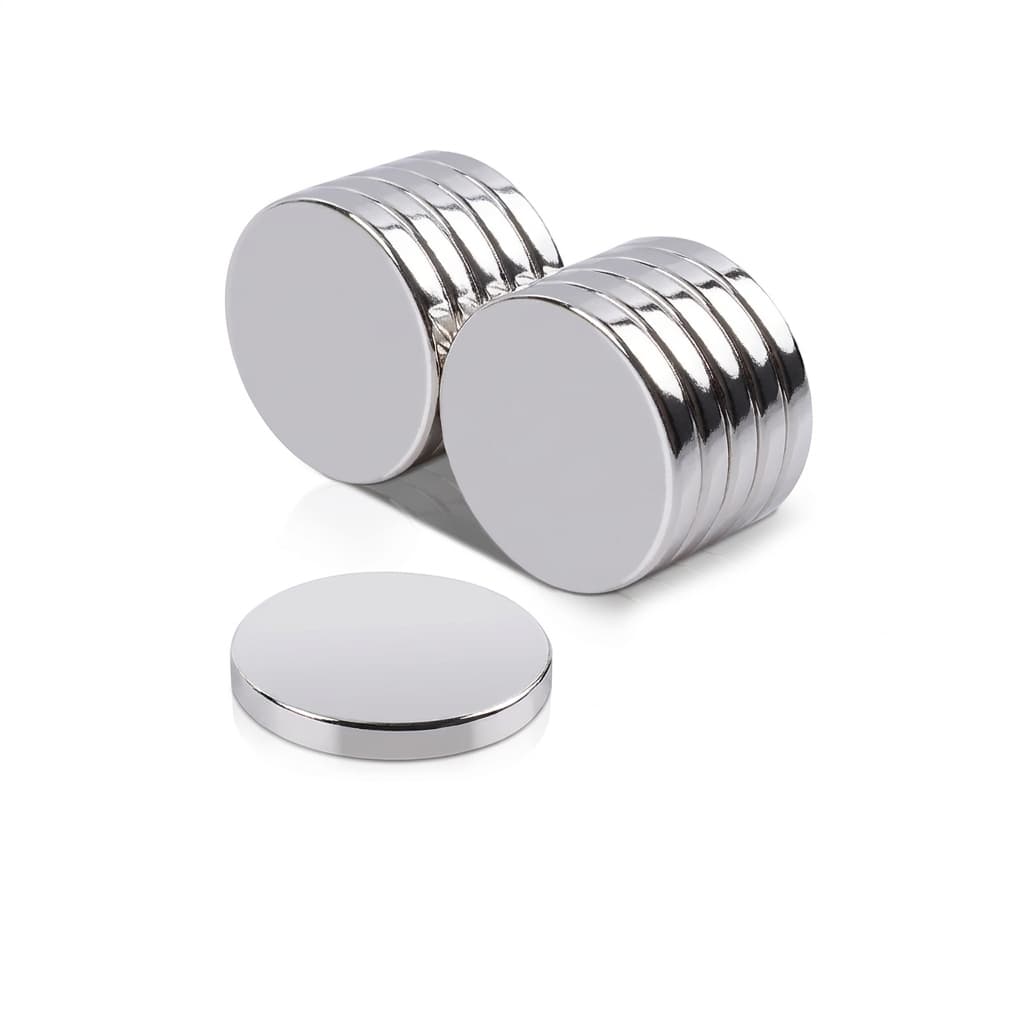
Alias size
1/2 in diameter; thickness TBD
Both the 1 2 in rare-earth discs phrase and “1 2 inch neodymium disc magnet” are interpreted as a 1/2 inch (12.7 mm) diameter request. Neither phrase states thickness; 3/16 inch is an editable tool default.
Material class
Sintered NdFeB
High-energy rare earth magnet. Available in grades from N35 to N52, with high-temp variants up to EH or AH.
Typical Use
Compact holding
Sensors, latches, craft, and industrial fixturing where space is limited but high axial force is required.
Use boundary
Validate by fixture
Pull force is an assembly-level result; target steel, air gap, shear load, coating, and temperature can change the outcome.
Use neodymium rare earth disc magnets when the assembly has a fixed envelope and the required force cannot be reached with a lower grade. Phrases such as “1 2 in neodymium rare-earth magnet discs” and “1 2 inch neodymium disc magnet” likely mean a 1/2 in (12.7 mm) diameter; confirm the units and thickness before requesting a quote.
The important boundary is that grades (e.g., N42, N52) are material grade signals, not finished assembly guarantees. They help screen magnetic energy density, but the RFQ still needs test geometry, coating, temperature, magnetization direction, and safety constraints.
If the searched requirement is a broader 0.5 inch magnet N50 rather than a general disc, use the canonical N50 magnet quick check before comparing grades.
This page uses public supplier technical data and exact unit conversion for screening. It does not claim a certified pull force because pull force is an assembly-level test result, not a grade name alone.
| Evidence point | Value used | Source / boundary |
|---|---|---|
| Neodymium disc strength | Highest room-temperature energy product among commercial magnets | Dura Magnetics MMPA standards and guidelines pointer; accessed July 27, 2026. |
| Catalog pull reference, N42 (1/2" dia. x 3/16" thk.) | 9.14 lbf (Case 1, thick steel plate) | K&J Magnetics D83 published pull reference; accessed October 6, 2026. |
| Catalog pull reference, N52 (1/2" dia. x 3/16" thk.) | 11.32 lbf (Case 1, thick steel plate) | K&J Magnetics D83-N52 published pull reference; accessed October 6, 2026. |
| Example catalog dimensional tolerance | ±0.004 in (±0.1 mm) for this D83 listing; not a universal standard | K&J Magnetics D83 product specification; accessed October 6, 2026. |
| Selection limits | Temperature, geometry, application requirement, and cost must be checked | Dura Magnetics NdFeB technical notes, accessed June 2026. |
| Grade naming boundary | Grade describes magnetic material properties, not a guaranteed pull force for every disc assembly | Dura Magnetics MMPA standards and guidelines pointer; accessed July 27, 2026. |
| Alias and editable default conversion | 1/2 in diameter = 12.7 mm; 3/16 in default thickness = 4.7625 mm | Exact inch-to-mm conversion using 25.4 mm per inch; thickness is an editable example, not part of the alias. |
| Mass estimate | Disc volume x 7.6 g/cm3 density | Public D83 catalog weight plus standard sintered NdFeB density screening; final lot weight should use supplier inspection data. |
These fields are the difference between a searchable part phrase and a buildable procurement specification. They should be frozen before pilot or production release.
| Field | Recommended RFQ wording | Why it matters |
|---|---|---|
| Grade | Specify exact grade (e.g., N42, N52) and max operating temp | Grade dictates magnetic properties. Avoid over-specifying N52 if N42 suffices for the gap/temperature. |
| Magnetization | Axial through thickness unless stated otherwise | Most disc magnets are axial, but diametric magnetization changes the usable field direction, fixture, inspection method, and lead time. |
| Operating temperature | State continuous and peak temperature; review H/SH/UH/EH variants for sustained heat | NdFeB has high temperature coefficients. Thermal margin can dominate grade choice in motors, sensors, and enclosed assemblies. |
| Coating | Ni-Cu-Ni for indoor use; epoxy or zinc only after exposure review | Sintered NdFeB is corrosion-sensitive. Coating choice affects corrosion resistance, adhesive bonding, thickness stack-up, and edge-chip acceptance. |
| Pull validation | Define target steel grade/thickness, gap, pull direction, fixture, speed, and pass value | A catalog pull number cannot be compared unless the test condition is known. Air gaps, paint, thin sheet, and shear loading change the result. |
Scenario 1
Use the calculator to screen size and mass, then validate axial pull with the real bracket coating.
Scenario 2
Check shear load separately; a cup assembly or steel return path may outperform a loose disc.
Scenario 3
Use 1/2 in neodymium rare earth disc magnets for trials, but freeze thickness, coating, and tolerance before production RFQ.
Neodymium disc magnets are often the right answer only when geometry is fixed and the assembly is room-temperature. The table below shows when a different design move can beat a higher grade.
If yes: Compare standard grades because geometry gain may be cheaper than jumping to the highest room-temperature grade.
If no: Higher grades like N48 or N52 become more relevant, but pull and thermal validation still decide whether it works.
If yes: Ask for high-temperature grade review (M, H, SH) instead of assuming standard grades have enough irreversible-loss margin.
If no: Standard N-grades can be screened for compact room-temperature assemblies.
If yes: Add a mechanical stop, pocket, cup, adhesive validation, or retaining feature. Axial pull estimates do not prove shear holding.
If no: Use axial pull screening, then validate on the real mating surface.
| Option | Best for | Tradeoff |
|---|---|---|
| Neodymium disc magnet | Small envelope with maximum room-temperature strength | Higher cost, corrosion prone without coating |
| Ceramic/Ferrite disc | Cost-sensitive or high-temp/corrosive environments | Much lower energy product; requires larger volume |
| Neodymium block or ring | Directional assembly constraints or mechanical locating features | Different tooling, tolerances, and magnetization checks |
| Assembly with steel cup | Holding applications that need more usable surface pull | Changes flux path, part envelope, corrosion design, and cost |
Compare grades, dimensions, and supplier requirements with these related guides and product references.
Impact: A single tolerance value does not apply to every size, coating, and manufacturing route. The cited D83 catalog listing specifies ±0.1 mm.
Mitigation: Set the finished-part tolerance from the assembly fit, then confirm capability, coating buildup, and inspection method with the supplier.
Impact: The alias indicates a likely 1/2 inch diameter but does not specify disc thickness or confirm units.
Mitigation: Confirm diameter, thickness, units, and finished dimensions on the drawing before quotation or purchase.
Impact: Air gap, paint, target steel, and shear loading can cut usable holding force sharply.
Mitigation: Use the quick check for RFQ screening, then request a sample pull test with the real mating surface.
Impact: N52 may add cost without improving the assembly if temperature, geometry, or steel saturation is the bottleneck.
Mitigation: Compare N42/N45/N52 against required safety factor, operating temperature, and available envelope.
Impact: Small discs are brittle and edge chips can start corrosion or reduce usable contact area.
Mitigation: Specify Ni-Cu-Ni, epoxy, zinc, or custom coating with salt-spray and handling acceptance criteria.
Updated October 6, 2026. The conclusions above use public supplier data, standards pointers, and safety resources. Where the final value depends on a buyer-specific fixture, the page marks the result as screening guidance rather than certified data.
K&J Magnetics lists 9.14 lbf for the N42 1/2 × 3/16 in D83 in pull Case 1; this is a catalog reference for thick steel, not an assembly guarantee. Accessed October 6, 2026.
K&J Magnetics lists 11.32 lbf for the N52 1/2 × 3/16 in D83-N52 in pull Case 1; this is a catalog reference, not an assembly guarantee. Accessed October 6, 2026.
Used as a standards pointer for permanent magnet material guidelines and grade-property framing. Accessed July 27, 2026.
Used for selection caveats around temperature, geometry, cost, and application constraints. Accessed June 2026.
It likely means a 1/2 in (12.7 mm) diameter, but the wording does not specify thickness or confirm units. The tool’s 3/16 in thickness is only a starting default; confirm both dimensions and drawing units before quotation.
A disc magnet made of sintered neodymium iron boron (NdFeB). NdFeB generally has the highest maximum energy product among commercial permanent-magnet materials at room temperature, but a disc’s actual pull depends on its dimensions and test conditions.
No. The tool calculates dimensions and weight, and shows a published pull reference only when a matching catalog size and grade are available. That reference is for thick steel; assembly pull needs an agreed test method, target steel, coating, temperature, magnetization direction, and tolerance.
Send diameter, thickness, tolerance, grade, coating, magnetization direction, quantity, destination, operating temperature, mating surface, and required validation tests.
Ni-Cu-Ni is common for general indoor use. Epoxy or other coatings may be better when corrosion, salt spray, adhesive bonding, or handling damage is a concern.
Different sellers use different steel plates, air gaps, coatings, test fixtures, and safety assumptions. Compare test conditions before comparing catalog numbers.
Standard N-grade NdFeB is usually treated as a room-temperature to moderate-temperature material. For sustained heat, ask for H, SH, UH, or EH grade review rather than assuming it will hold margin.
Yes. Most small disc magnets are axially magnetized through thickness, but diametric or multipole requirements must be stated explicitly because fixtures and inspection differ.
Inquiry Email